
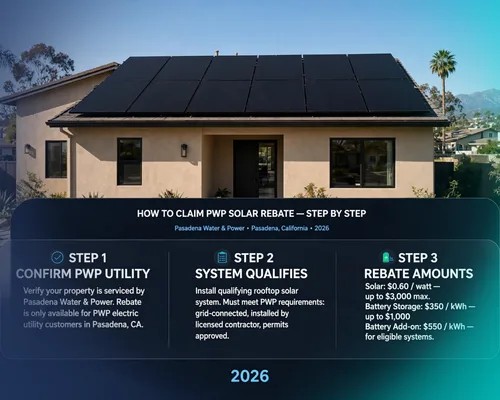

Pasadena Water and Power (PWP) pays eligible residential customers $0.60 per watt for a new rooftop solar system and $350 per kWh for a home battery, with higher rates for income-qualified households. The money does not arrive automatically after installation. You need final Net Energy Metering (NEM) approval, a complete application through PWP’s online portal, and you have to file within 180 days.
This guide covers the PWP solar and battery rebate in the order you will actually do it: who qualifies, what it pays, which documents to upload, how long the check takes, and which mistakes get applications delayed. We checked every figure against PWP’s official residential solar rebate and battery storage rebate pages on September 25, 2026.
PWP Solar and Battery Rebate at a Glance (2026)
PWP launched the solar and battery rebate as a pilot program in April 2026. Here is the short version:
| Item | Solar rebate | Battery rebate |
|---|---|---|
| Standard rate | $0.60 per watt (CEC-AC) | $350 per kWh |
| Enhanced rate | $1.00 per watt for customers enrolled in EUAP, Cares or Cares Plus | Extra $200 per kWh (up to $550 per kWh) for income-qualified or Medical Assistance Program customers |
| Who can apply | PWP residential electric customers | PWP residential electric customers |
| Install date | On or after January 1, 2026 | On or after January 1, 2026 |
| Ownership | Customer-owned only (no leases or PPAs) | Customer-owned only (no leases or PPAs) |
| Installer | Licensed contractor | Licensed C-10 electrical contractor |
| Filing deadline | 180 days from interconnection date | 180 days from final permit approval |
| Payout time | 6 to 8 weeks after approval | 6 to 8 weeks after approval |
| Lifetime limit | One rebate per service address | One rebate per service address |
| Extra condition | Final PWP NEM approval first | 36-month demand response or virtual power plant enrollment |
PWP is also waiving its plan review and inspection fees for solar and battery projects during the pilot. That waiver only covers PWP-related costs. Structural, Building and Safety, meter, and other non-energy fees may still apply.
Who Qualifies for the PWP Solar Rebate?
You qualify for the PWP solar rebate when all of the following are true:
- You are a PWP residential electric customer.
- Your system is a new, permanent rooftop solar PV system (an expansion of an existing system also counts).
- The system was installed on or after January 1, 2026.
- You purchased and own the system. Leased systems and Solar Power Purchase Agreements (PPAs) do not qualify.
- A licensed contractor installed it.
- It meets PWP’s interconnection requirements and capacity limits (measured in CEC-AC output).
- You have not already received a rebate for this service address.
Are You Actually a PWP Customer?
PWP is a city-owned utility that serves electric customers inside the City of Pasadena. It is separate from Southern California Edison (SCE) and from statewide programs run through investor-owned utilities. Homes just outside city limits may be served by a different utility, and a different utility means a different rebate process. Check your latest electric bill before you assume this program applies to you.
How to Claim the PWP Solar Rebate: 6 Steps
Step 1: Confirm PWP Is Your Electric Utility
- Look at the utility name on your most recent electric bill.
- Confirm the rebate is for your residential electric service address.
- If you are on SCE or another utility, stop here. This program will not apply to you.
Step 2: Confirm Your System and Equipment Qualify
Check these points with your installer before you sign a contract:
- Ownership: the contract must be a purchase (cash or loan). Ask your installer to confirm in writing that it is not a lease or PPA. If you are still comparing options, read our solar lease vs loan comparison first.
- System size: PWP requires solar systems between 1 kW and 1,000 kW CEC-AC, sized to produce no more than 150% of your average annual electricity use.
- Equipment: panels, inverters, and meters must be new and listed on the California Energy Commission’s eligible equipment lists.
- Warranty: PWP requires a minimum 10-year combined manufacturer and installer warranty on the solar system.
- Pre-approval: PWP requires an initial review approval before you apply for a building permit.
Ownership trips up more homeowners than any other rule. It does not matter who installed the system or how it looks on your roof. If a third party owns the equipment, the rebate does not apply. Our list of questions to ask a solar installer includes how to confirm this before you commit.
Step 3: Install and Get Final PWP NEM Approval
After your licensed contractor finishes the installation, your system needs final PWP Net Energy Metering (NEM) approval. This is the gate for the whole rebate. You cannot submit the solar rebate application before it clears.
- Ask your installer who is responsible for the NEM filing.
- Get written confirmation once PWP approves the system.
- Note the date of interconnection. Your 180-day filing window starts here.
PWP calls its export credit program Net Surplus Compensation, which is also known as Net Energy Metering. It is PWP’s own program, so statewide NEM rules written for investor-owned utilities do not apply to your account.
Step 4: Gather the Documents PWP Asks For
Applications stall on missing paperwork more than anything else. Have these ready before you open the portal:
| Rebate | Documents to upload |
|---|---|
| Solar | Paid invoice showing total project cost, date of project completion, project address, and total solar PV system capacity (CEC-AC). Net Energy Metering (NEM) Agreement Form. Confirmation of final system capacity (CEC-AC output) |
| Battery | Final, signed electrical permit. Final paid, itemized invoice from your licensed electrician, including their license number and business information. Invoice details: total project cost, completion date, project address, battery capacity, and brand and model of the battery, inverter, and monitoring control. Signed PWP demand response (DR) or virtual power plant (VPP) agreement form |
If you are applying for the enhanced rate, you must be enrolled in the qualifying assistance program at the time you submit your application. Enrolling afterward does not count.
Step 5: Submit Your Application Within 180 Days
Submit your application through PWP’s online portal. The clock works differently for each rebate:
- Solar: the completed application must be received within 180 days of your interconnection date.
- Battery: the completed application must be received within 180 days of final permit approval.
Submit as soon as your documents are complete. PWP describes the funds as limited, and the program is a pilot.
Step 6: Wait for Review and Your Rebate Check
- Once PWP approves your application, the rebate check arrives in 6 to 8 weeks.
- PWP may verify your purchase and installation before or after it pays the rebate.
- Keep copies of everything you upload, plus your NEM approval. If the check does not match the amount you calculated, your own records make it much easier to resolve with PWP.
PWP Battery Rebate Requirements
The battery rebate has stricter equipment rules than the solar rebate. Make sure your installer’s proposal meets every line below before you buy.
| Requirement | What PWP requires |
|---|---|
| Certification | New UL 9540 home battery energy storage system using UL 9540A tested components |
| Installer | Licensed C-10 electrical contractor |
| Duration | Minimum two hours at continuous rating |
| Efficiency | Round-trip efficiency of at least 85% |
| Controls | Remote telemetry and control through the manufacturer’s portal or an approved aggregator API |
| Warranty | Minimum 10-year manufacturer warranty with at least 70% capacity at end of term |
| Interconnection | IEEE 1547 compliant where applicable, and meets PWP interconnection requirements |
| Ownership | Customer-owned (no leases or PPAs) |
PWP’s battery page does not list solar pairing as a requirement. If you plan to install a standalone battery, confirm with PWP before you buy. For pricing context on the equipment itself, see our guide to solar battery cost per kWh.
The 36-Month Demand Response Commitment
The battery rebate comes with a condition that is easy to miss. It is a package deal, not two separate choices:
- You must enroll in PWP’s first applicable demand response (DR) or virtual power plant (VPP) program for at least 36 months after that program launches.
- Enrollment must happen within 90 days of program launch if your site is technically eligible.
- You authorize PWP to use your interval meter data and device telemetry for operations and verification.
- If you decline to enroll without an approved exemption, or exit within the first 12 months after launch, PWP may claw back 20% of the original incentive on a pro rata basis.
Decide whether you are comfortable with this commitment before you install, not after.
How Much Is the PWP Rebate Worth? (Example)
Here is a sample calculation for a home with a 6 kW CEC-AC solar system and a 10 kWh battery:
| Item | Standard rate | Enhanced rate |
|---|---|---|
| Solar (6,000 W) | $3,600 ($0.60/W) | $6,000 ($1.00/W) |
| Battery (10 kWh) | $3,500 ($350/kWh) | $5,500 ($550/kWh) |
| Total rebate | $7,100 | $11,500 |
- The solar rebate uses CEC-AC output, not the DC panel rating. Your proposal may list a larger DC number, so use the CEC-AC figure from your paperwork.
- Battery capacity: use the capacity listed on your invoice, and ask PWP whether it applies usable or nominal kWh.
- Your rate is locked at purchase. PWP calculates the rebate using the incentives posted on its website on the date you purchase the product.
To see what a rebate does to your total price, try our solar cost calculator. For a baseline before incentives, see Pasadena solar panel costs. To see how the rebate moves your break-even date, read our guide to the solar panel payback period.
PWP Rebate Timeline: What to Expect
| Stage | What happens | Timing |
|---|---|---|
| 1. Pre-approval and permits | Initial PWP review approval, then building permit | Before installation |
| 2. Installation | Licensed contractor installs and interconnects the system | Varies by project |
| 3. Final approval | Final NEM approval (solar) or final signed permit (battery) | Starts your 180-day clock |
| 4. Application | Upload documents in PWP’s online portal | Within 180 days |
| 5. Review | PWP reviews and approves the application | Varies |
| 6. Payment | Rebate check arrives | 6 to 8 weeks after approval |
PWP Rebate vs SGIP: Which One Applies to Pasadena Customers?
Many California rebate guides focus on the Self-Generation Incentive Program (SGIP), the statewide battery incentive. Pasadena’s program is separate:
| PWP solar and battery rebate | SGIP (statewide) | |
|---|---|---|
| Run by | Pasadena Water and Power | Program administrators in investor-owned utility territories, under CPUC oversight |
| Covers | Solar and battery | Battery storage only |
| Where you apply | PWP’s online portal | The SGIP program portal |
| Funding | Pilot program with limited funds | Incentive levels step down as funds are reserved |
PWP is a city-owned utility, so Pasadena customers file through PWP. If you are unsure which program fits your address, ask PWP or your installer before you file. For the statewide picture, see our California solar rebate guide and our roundup of 2026 solar incentives.
Common Mistakes That Delay or Cancel a PWP Rebate
- Missing the 180-day window. Late applications do not qualify. Note your interconnection date or final permit date the day it happens.
- Assuming a lease or PPA qualifies. PWP requires customer-owned systems.
- Filing before final NEM approval. The solar application depends on it.
- Sending an incomplete invoice. PWP lists specific items the invoice must include, such as completion date, project address, and system capacity.
- Buying a battery that misses the technical rules. UL 9540, a C-10 installer, 85% round-trip efficiency, and the warranty terms are all required.
- Ignoring the demand response commitment. Skipping enrollment can trigger a 20% clawback.
- Enrolling in an assistance program too late. You must be enrolled when you submit the application to get the enhanced rate.
- Expecting a second rebate at the same address. PWP sets a lifetime limit of one rebate per service address.
Who Should File First?
PWP says program funds are limited and reserves the right to change terms, so timing matters most in these situations:
- Homeowners with a system already installed. Check your interconnection date now. The 180-day clock may already be running.
- Income-qualified households. The enhanced rate is worth thousands more, so confirm your program enrollment before you submit.
- Anyone planning a battery. Decide on the 36-month enrollment commitment before you buy.
Get Your PWP Rebate Filed Correctly the First Time
Claiming the rebate is not complicated, but the order matters: confirm eligibility, install with a licensed contractor, secure final NEM approval, gather your documents, then file within 180 days. US Power’s consultants handle the NEM filing, the rebate application, and the enrollment paperwork as part of a standard installation, as described in the company’s recent announcement. For long-term returns after the rebate, see US Power’s Pasadena ROI breakdown.
Ready to see your numbers? Use the solar savings calculator to see how a claimed rebate changes your monthly and long-term savings, or get your free estimate and find out what you qualify for before you file anything.
Frequently Asked Questions About the PWP Solar Rebate
Does Pasadena have a solar rebate?
Yes. Pasadena Water and Power pays eligible residential electric customers $0.60 per watt for a new, permanent rooftop solar system, or $1.00 per watt for customers enrolled in an income-qualified bill assistance program. The system must be customer-owned and installed on or after January 1, 2026.
How much is the PWP battery rebate?
The standard rebate is $350 per kWh. Customers enrolled in an income-qualified program or the Medical Assistance Program get an additional $200 per kWh, for up to $550 per kWh.
How do I apply for the PWP solar rebate?
After your system receives final PWP NEM approval, submit an application through PWP’s online portal. Upload a paid invoice, your NEM Agreement Form, and confirmation of your final CEC-AC system capacity.
Is there a deadline to apply for the PWP rebate?
Yes. For solar, PWP must receive your completed application within 180 days of your interconnection date. For batteries, the window is 180 days from final permit approval.
How long does the PWP rebate take to pay out?
Your rebate check arrives 6 to 8 weeks after PWP approves your application.
What documents do I need for the PWP rebate?
For solar, you need a paid invoice, the NEM Agreement Form, and confirmation of final CEC-AC capacity. For a battery, you need the final signed electrical permit, a paid, itemized invoice from your licensed electrician, and the signed PWP demand response or virtual power plant agreement form.
Do leased or PPA solar systems qualify for the PWP rebate?
No. Both the solar and battery rebates require a customer-owned system. Systems that are leased or purchased through a Power Purchase Agreement are not eligible.
Is demand response enrollment required for the battery rebate?
Yes. You must enroll in PWP’s first applicable demand response or virtual power plant program for at least 36 months after it launches. Declining without an approved exemption, or leaving within the first 12 months after launch, can lead to a 20% clawback of the original incentive.
Can I apply if my system is already installed?
Yes, if it was installed on or after January 1, 2026, and you file within the 180-day window. Funds are limited, so apply as soon as your documents and NEM approval are ready.
Can I get the PWP rebate more than once?
No. Each program page lists a lifetime limit of one rebate per PWP residential electric service address.
Is the PWP rebate the same as SGIP?
No. SGIP is a statewide battery-only incentive run in investor-owned utility territories. PWP’s rebate is a separate city program that covers both solar and battery storage, and Pasadena customers file through PWP.